
Replacements, widening & approaches
Concrete Driveways in Tigard, OR
A driveway that drains, carries your vehicles and still has traction on a wet January morning.
- Free on-site measuring and a written, itemized quote
- Drainage and slope planned before any forms go in
- Repair or leveling quoted when it beats a tear-out
Driveways That Shed Water, Not Panels
Concrete driveways in Tigard take a steady soaking for most of the year. Plantmaps lists about 41.8 inches of precipitation annually, and every gallon that lands on the slab, the roof and the yard has to go somewhere. When the ground beneath a driveway stays saturated, it softens, the slab loses support, and panels tip, crack and settle. Many of the drives we replace were poured on native soil in the 1970s and 1980s, the decades when, per Point2Homes, about 40 percent of Tigard's homes went up.
Signs a driveway has reached the end
- Panels that have dropped and now hold a puddle near the garage
- Cracks with one side higher than the other
- Large areas of flaking or crumbling surface
- Water running toward the garage or the foundation
- A broken approach at the street or crumbling edges along the lawn
- Tree roots lifting whole sections
- Not enough width for the cars you own now
One sunken panel on an otherwise solid driveway can often be lifted or replaced on its own. When settling, cracking and drainage problems show up together, a full replacement usually makes more sense than patching.
Built from the bottom up
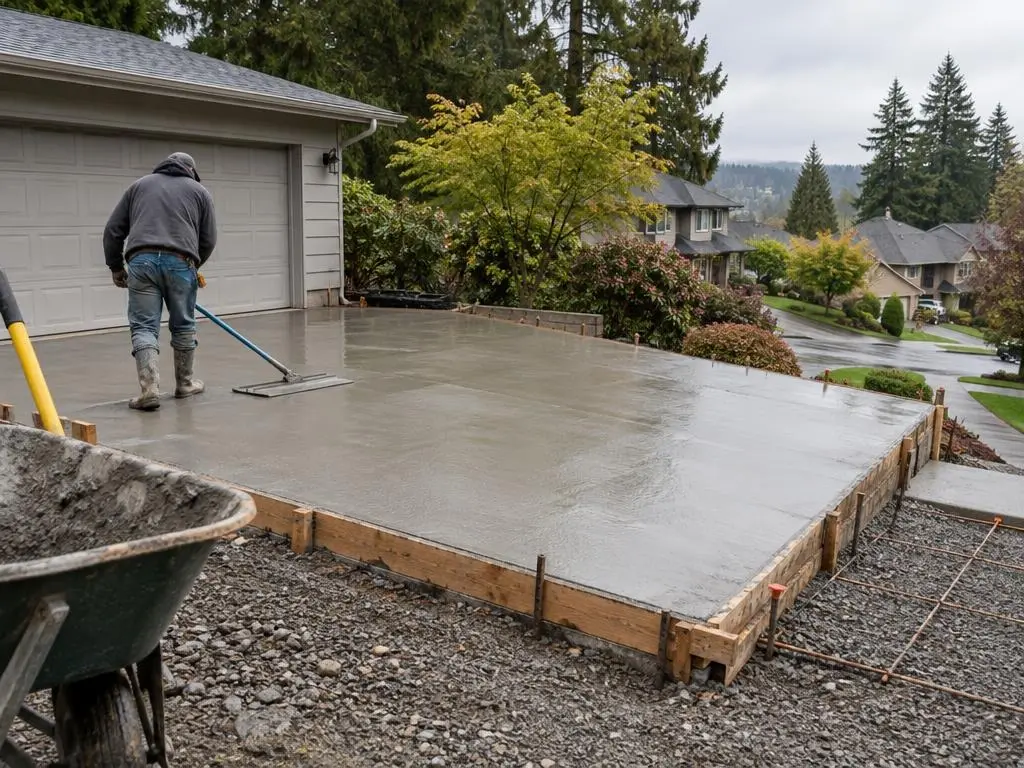
We remove the old slab or asphalt, dig out soft or organic soil, and replace it with crushed rock compacted in layers. That base carries the load and lets water move out from under the concrete instead of sitting there. Forms are set so the finished drive falls toward the street or a planned drain, never back toward the garage.
Thickness follows what parks on it. HomeGuide's driveway guide calls for at least 4 inches for passenger vehicles, 5 to 6 inches for RVs and heavy vehicles, and thickened edges of 6 to 8 inches. If a boat, camper or work truck lives on the drive, that area gets more depth and steel. Joints are sawn or tooled on a planned layout so shrinkage cracks follow straight lines.
Slopes and Bull Mountain lots
On the hillier streets west of downtown, a driveway can be steep enough that the finish becomes a safety question. We give sloped drives a heavier broom or an exposed-aggregate surface, and we look hard at where runoff from the street and the uphill neighbor will go. A trench drain at the bottom of a steep drive is sometimes the difference between a dry garage and a wet one.
The approach at the street
The section between the street and your property line is the driveway approach, and Tigard regulates it. Under Tigard Municipal Code 15.10.020, a residential approach can be up to 30 feet wide including its end slopes, must sit at least 6 feet from the projected side property line (with some exceptions), and cannot come within 30 feet of an intersecting street right-of-way. Approach work goes through the city's Public Facilities Improvement permit, and if you move a driveway, section 15.10.040 requires the old approach to be removed and the curb restored. Our quote shows the approach as its own line so the permit and the private work are clear.
Finish choices
- Broom finish: the standard choice, with ridges that give grip in rain.
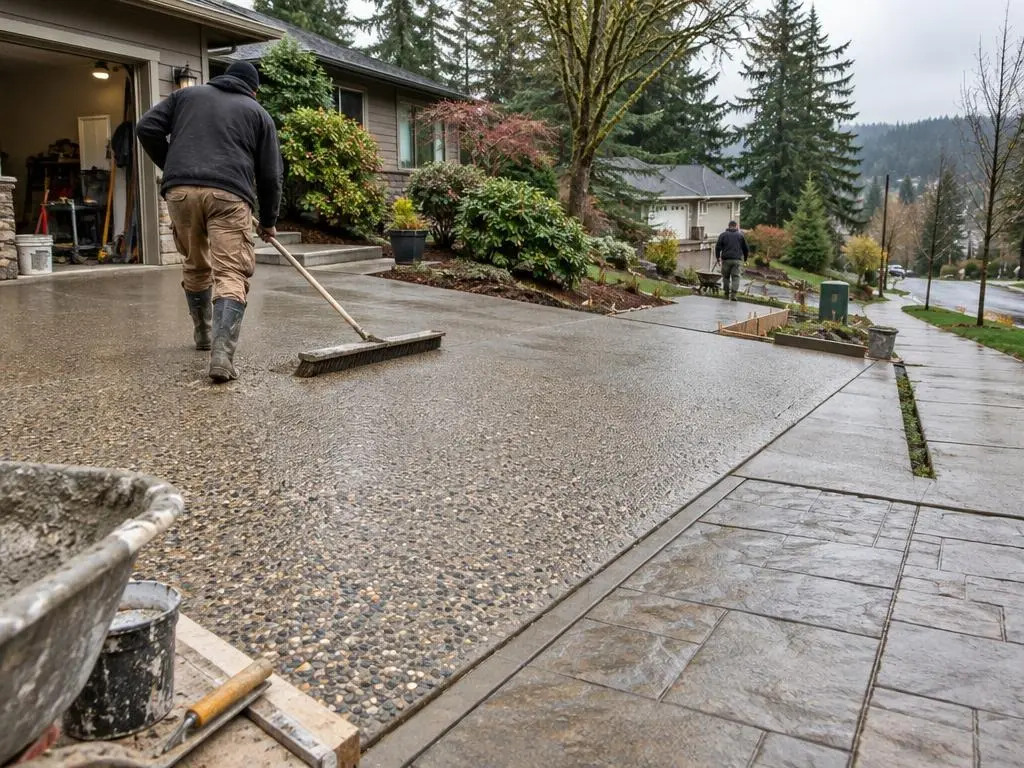
- Exposed aggregate: the top paste is washed away to show the stone, which hides wear and grips well; HomeGuide groups it with basic decorative finishes at $10 to $15 a square foot.
- Decorative borders: a stamped or colored band along the edges, with plain concrete in the wheel lanes.
- Smooth trowel: we avoid it on driveways here because it turns slick when wet.
After the pour
Stay off with vehicles for at least seven days and keep heavy trucks off for about 30, per HomeGuide. HomeGuide also recommends waiting 28 to 30 days before the first coat of sealer and resealing every 2 to 3 years, which helps a driveway shed water and resist moss. Keep downspouts discharging away from the slab, and clear needles and leaves so they do not stain the surface or hold moisture.
What a Driveway Quote Covers
Each of these appears as its own line, so nothing is buried in a lump sum.
Removal and haul-off
Old concrete, asphalt or gravel broken out and taken away, along with soft soil below.
Compacted rock base
Crushed rock placed and compacted in lifts for support and drainage.
Grading and forms
A planned fall toward the street or a drain, away from the garage and house.
Reinforcement
Rebar or wire mesh sized to the slab and what parks on it.
Pour, texture and joints
Concrete placed, broomed or exposed, and jointed on a layout.
Approach and extensions
The city-permitted approach, plus parking pads or widening tied into the existing drive.
Typical Concrete Driveway Costs
| Item | Published range |
|---|---|
| Standard broom-finish driveway, per sq ft | $6 to $10 |
| Basic decorative (exposed aggregate, border), per sq ft | $10 to $15 |
| One-car, 12 x 24 ft | $1,700 to $4,300 |
| Two-car, 20 x 20 ft | $2,400 to $6,000 |
| Two-car, 24 x 24 ft | $3,500 to $8,600 |
| Old driveway removal, per sq ft | $2 to $6 |
| Grading, per sq ft | $3 to $8 |
| Sealing, per sq ft | $1 to $3 |
Figures from HomeGuide's concrete driveway cost guide (national averages, 2025). Tigard prices can be higher or lower, and removal, slope, access, thickness and finish all change the total. City PFI permit fees for approach work are separate. Your written estimate is the price.
From Estimate to Driving On It
1. Measure and assess
We check slope, drainage, roots and the approach, then send a written quote.
2. Permit and prep
Any approach permit is secured, the old drive comes out and the rock base is compacted.
3. Pour
Forms, reinforcement, concrete, texture and joints, on a dry-weather day.
4. Cure and hand off
You get written dates for parking, heavy vehicles and the first seal.
Why Choose Us for Concrete Driveways
Drainage planned
Fall, drains and downspouts worked out before the forms go in.
Approach clearly separated
The permitted city section is priced and scheduled on its own.
Concrete Driveways Questions
How long does a concrete driveway last?
HomeGuide puts a well-built, maintained concrete driveway at 30 to 40 years. In Tigard the base and drainage decide most of that, followed by regular sealing.
How thick should my driveway be?
At least 4 inches for cars, and 5 to 6 inches for RVs or heavy vehicles, with thicker edges, per HomeGuide. We add depth where trailers or work trucks park.
How wide can my driveway approach be in Tigard?
Tigard Municipal Code 15.10.020 caps a residential approach at 30 feet wide including end slopes and requires it to sit at least 6 feet from the projected side property line, with limited exceptions. Approach work needs the city's PFI permit.
Can new concrete be poured over my old driveway?
We rarely recommend it. An overlay on a cracked or sunken drive keeps the same problems and raises the surface at the garage and street. Removing it and fixing the base lasts longer.
When can I park on a new driveway?
HomeGuide says to wait at least seven days for cars and about 30 days for heavy vehicles. We give you dates based on your pour and the weather that week.
Concrete Driveways Service Areas
- Concrete Contractors in Tigard, OR
- Concrete Contractors in Portland, OR
- Concrete Contractors in Beaverton, OR
- Concrete Contractors in Hillsboro, OR
- Concrete Contractors in Lake Oswego, OR
- Concrete Contractors in Tualatin, OR
- Concrete Contractors in Sherwood, OR
- Concrete Contractors in King City, OR
- Concrete Contractors in Durham, OR
- Concrete Contractors in Bull Mountain, OR
- Concrete Contractors in Metzger, OR
- Concrete Contractors in Garden Home–Whitford, OR
- Concrete Contractors in West Linn, OR
- Concrete Contractors in Wilsonville, OR
- Concrete Contractors in Oregon City, OR
- Concrete Contractors in Milwaukie, OR
- Concrete Contractors in Gladstone, OR
- Concrete Contractors in Oak Grove, OR
- Concrete Contractors in Happy Valley, OR
- Concrete Contractors in Aloha, OR
- Concrete Contractors in Cedar Mill, OR
- Concrete Contractors in Bethany, OR
- Concrete Contractors in Newberg, OR
- Concrete Contractors in Canby, OR
- Concrete Contractors in Forest Grove, OR
Get a Concrete Driveways Estimate
We measure your driveway and approach and price it in writing, in Tigard and nearby towns.